
In the complex landscape of industrial fluid handling, automotive manufacturing, and heavy equipment engineering, successful operations often hinge on the reliability of the smallest components. If you are involved in plant maintenance, MRO (Maintenance, Repair, and Operations) procurement, or OEM design, you have likely asked, what is a clamp in the context of high-pressure, mission-critical systems? A hose clamp is a precision-engineered fastening device designed to secure a hose over a fitting, barb, or nipple, creating a leak-proof seal by exerting uniform radial pressure.
For procurement professionals and engineers, understanding the different types of hose clamps is not merely a matter of technical curiosity; it is a prerequisite for ensuring system integrity, preventing costly downtime, and maintaining workplace safety. Selecting the wrong fastener can lead to catastrophic joint failure, environmental contamination, and expensive warranty claims. This guide provides a deep dive into the primary hose clamp types available in the B2B market, offering the technical insights needed to make informed purchasing decisions.
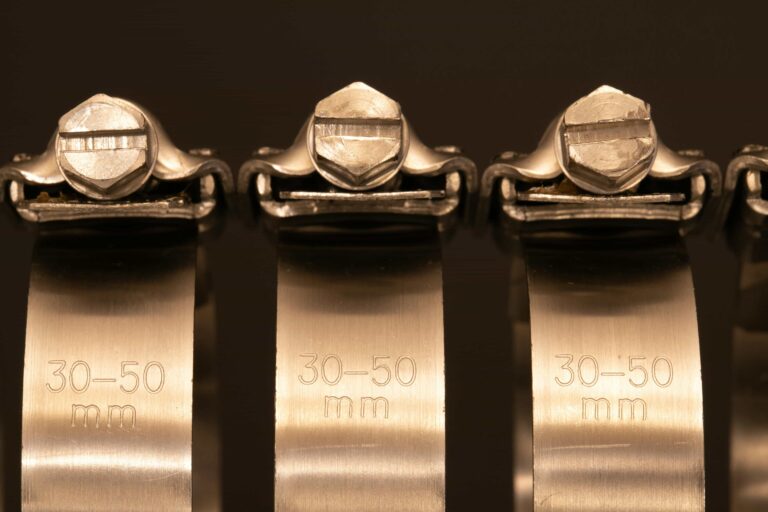
A high-definition, close-up photograph of three distinct industrial hose clamps arranged neatly on a brushed stainless steel surface in an engineering workshop. From left to right: a classic worm gear clamp, a robust heavy-duty T-bolt clamp, and a spring-steel constant tension clamp. The lighting is crisp and industrial, highlighting the metallic textures. Shallow depth of field with a blurred background of industrial machinery. Professional, B2B aesthetic.]
Part 1: What is a Hose Clamp? The Foundation of Fluid Connections
At its core, what is a clamp designed to achieve? Its primary function is to provide a comprehensive, 360-degree radial seal between the inner diameter of a hose and the outer diameter of a rigid fitting. However, in industrial applications, the demands placed on this simple concept are immense.
A professionally engineered hose clamp must facilitate several critical requirements:
- Leak Prevention: It must maintain a positive seal against internal fluid or pneumatic pressure, preventing loss of media, whether it be hydraulic oil, coolant, fuel, or compressed air.
- Pull-off Resistance: In high-vibration environments or systems subject to physical shock, the clamp must prevent the hose from being mechanically disconnected from the fitting.
- Environmental Resistance: The clamp must withstand the external operating environment, which may involve exposure to corrosive chemicals, salt water, extreme UV radiation, or fluctuating temperatures.
- Hose Integrity: A high-quality clamp provides sealing pressure without damaging the hose material. Poorly designed clamps can cut into the hose cover, leading to premature failure.
The complexity arrives when you realize that hoses are made from varied materials—silicone, EPDM, Nitrile, PVC—each with different hardness (durometer) and thermal expansion characteristics. This variability necessitates different types of hose clamps, each utilizing a different mechanical principle to achieve the perfect seal
Part 2: Three Main Types of Hose Clamps
While numerous specialized fasteners exist, the vast majority of industrial, automotive, and marine applications can be serviced by three foundational categories of hose clamps. Understanding the mechanical mechanism, strengths, and limitations of these three hose clamp types is essential for any B2B buyer.
1. Worm Gear Clamps: The Versatile Workhorse
The worm gear clamp, sometimes referred to as a band clamp or by the brand name “Jubilee clip” (primarily in the UK), is the most common and versatile clamping solution. Its design is brilliant in its simplicity and efficiency.
Mechanical Principle
It consists of a continuous metal band, often perforated with rectangular slots (or featuring embossed threads). A captive screw (the “worm”) is housed in a housing attached to one end of the band. When the screw is turned using a screwdriver or socket wrench, its threads engage with the slots or embossing on the band. This action pulls the band through the housing, reducing the diameter of the loop and tightening it around the hose.
B2B Applications and Key Industries
Worm gear clamps are ubiquitous across multiple sectors:
- Automotive/Transportation: Used for low-pressure coolant lines, air intake systems, and fuel vent lines.
- MRO (Maintenance, Repair, and Operations): The go-to clamp for general repair of plumbing, ventilation, and low-pressure fluid transfer in manufacturing facilities.
- Agriculture: Ideal for irrigation lines and fluid transfer on farm machinery where high pressure is not a concern.
- Marine: Specific high-grade stainless steel versions are used for onboard low-pressure plumbing (e.g., bilge pumps).
Critical Advantages for Procurement
- Wide Adjustment Range: A single worm gear clamp can accommodate a significant variety of hose diameters. For MRO inventories, this means stocking fewer SKUs to cover a broad range of maintenance needs.
- Ease of Installation: No specialized tools are required. They can be installed and adjusted quickly using standard hexagonal sockets or flathead/Phillips screwdrivers.
- Availability: They are produced globally in massive volumes, ensuring low cost per unit and high availability.
Technical Limitations
The primary drawback of the standard perforated worm gear clamp is its potential to damage softer hose materials. Under high torque, the slots in the band can act like a cheese grater, shearing the hose cover or allowing the inner tube to extrude through the slots, causing a leak path. Procurement Note: For silicone hoses, always specify “lined” or “smooth band” worm gear clamps to prevent this damage.
A macro photograph focusing on the screw mechanism of a stainless steel worm gear clamp. The screw is actively engaging with the perforations on the metal band, which is tightened around a black rubber hydraulic hose. The image should show the compression of the rubber slightly under the band, demonstrating the sealing action. The background is a clean, slightly blurred industrial test bench.]
2. T-Bolt Clamps: The Heavy-Duty Powerhouse
When the application demands maximum sealing pressure, exceptional tensile strength, and superior resistance to vibration, the standard worm gear clamp is often insufficient. This is where the T-bolt clamp, or heavy-duty band clamp, is required. It is engineered for critical joints where failure is not an option.
Mechanical Principle
T-bolt clamps utilize a solid, heavy-gauge metal band without perforations. The tightening mechanism is completely different. One end of the band features a pivoted T-bolt, while the other end has a slotted trunnion or bridge. The T-bolt swings into the slot, and a self-locking hexagonal nut is tightened onto the bolt. As the nut is torqued down, it draws the two ends of the high-tensile band together, generating immense, uniform radial pressure.
B2B Applications and Key Industries
T-bolt clamps are standard specifications in heavy industrial and high-performance sectors:
- Heavy Equipment & Construction: Crucial for secure connections on large diesel engines, turbocharger charge air cooler (CAC) systems, and high-pressure coolant lines in excavators and dozers.
- Truck & Bus OEM: Used extensively in commercial vehicle powertrains for air intake and cooling systems due to their ability to handle high vibration and thermal cycling.
- Industrial Processing: Ideal for secure connections on process piping, large filtration systems, and pumping stations handling semi-viscous fluids.
- High-Performance Automotive: A staple in aftermarket turbo and supercharger installations where boost pressures are high.
Critical Advantages for Procurement
- High Sealing Integrity: The solid band distributes pressure much more evenly than a perforated band, minimizing the risk of “cold flow” leaks and providing a superior 360-degree seal.
- Exceptional Torque and Tensile Strength: T-bolt clamps can withstand significantly higher installation torques, translating to much higher internal pressure ratings for the final hose assembly.
- Durability and Reusability: Built from heavier gauge materials (often exclusively 300-series stainless steel), they are exceptionally durable and can often be reused after maintenance (provided the self-locking nut is replaced).
Technical Limitations
- Narrow Adjustment Range: Unlike worm gear clamps, T-bolt clamps have a very limited diameter range. When ordering, procurement managers must know the precise Outside Diameter (OD) of the hose after it is installed on the fitting. Miscalculation by even 2-3mm can render the clamp unusable.
- Higher Cost: Due to the material gauge and the machined components (the bolt, trunnion, and nut), the cost per unit is substantially higher than worm gear clamps.
An extreme close-up of a high-polish stainless steel T-bolt clamp installed on a large, blue silicone charge-air cooler hose of a diesel engine. The image should clearly show the heavy-duty nut, bolt, and the trunnion bridge mechanism under tension. Dust and slight oil residue on the engine block nearby emphasize the real-world industrial setting. High-contrast lighting.]
3. Spring Clamps (Constant Tension Clamps): The Thermal Dynamics Expert
The third essential category takes a completely different approach to clamping. Instead of relying on a screw or bolt mechanism that stays static after installation, the spring clamp—often called a constant tension clamp—is a dynamic fastener designed to adapt to the changing physical properties of the joint.
Mechanical Principle
Spring clamps are manufactured from a single, continuous band of high-carbon spring steel, tempered for exceptional memory and tensile strength. The band is formed into a pre-tensioned ring with two projecting tabs or “ears.” In its rest state, the ring’s diameter is smaller than the hose it is intended for. To install, specialized pliers are used to squeeze the ears together, expanding the diameter of the ring. It is slid over the hose and fitting, and when the pliers are released, the spring steel naturally attempts to return to its original shape, exerting constant, uniform radial pressure on the hose.
B2B Applications and Key Industries
These are almost mandatory in environments with extreme temperature fluctuations:
- Automotive Cooling Systems: The premier application. Engine coolants cycle from ambient temperature (e.g., -20°C) to operating temperature (e.g., 105°C) rapidly. Rubber and silicone hoses expand and contract with this heat. A spring clamp tracks this movement, maintaining the seal when other clamps would loosen.
- HVAC Systems: Used in commercial heating and cooling lines subject to thermal cycling.
- Appliance Manufacturing: Ideal for washing machines and dishwashers where hot water cycling is common.
Critical Advantages for Procurement
- Elimination of “Cold Flow” Leaks: When hoses get cold, they contract. A screw-tightened clamp becomes relatively loose, creating a leak path (often seen as small puddles under a car in winter). A spring clamp automatically contracts with the hose, preventing this common failure.
- Uniform Sealing: The design inherently provides very uniform radial pressure, minimizing stress concentrations on the hose material.
- Fast, Error-Free Installation in OEM: In a mass-production environment, spring clamps allow for very rapid installation without the risk of operators over-torquing or under-torquing the fastener.
Technical Limitations
- Installation Tool Required: They cannot be installed with standard tools; specialized spring clamp pliers are necessary, which can be difficult to use in tight, confined spaces.
- Not for High-Pressure: While excellent for temperature, they generally lack the raw tensile strength and pressure-handling capabilities of T-bolt clamps. They are unsuitable for hydraulic or high-boost air systems.
A professional product lineup shot showing four spring clamps of different sizes, made from dark, tempered spring steel. They are arranged diagonally on a clean, light grey industrial resin floor. The focus is sharp on the two intermediate-sized clamps, showing their smooth, continuous construction and the shape of the installation “ears.” Soft, ambient industrial overhead lighting.]
Part 3: How to Choose the Right Hose Clamps (The B2B Procurement Checklist)
For an OEM or MRO procurement manager, sourcing hose clamps is a optimization challenge involving cost, performance, and risk management. Below is a formalized checklist to ensure you select the appropriate hose clamp types for your application.
1. Define the Required Outside Diameter (OD)
This is the single most common failure point in procurement.
- Do Not Base Purchase on Nominal Hose ID: A 1-inch ID (Inside Diameter) hose will have a much larger OD once pushed onto a 1-inch barb.
- Action: Measure the hose’s OD after it has been assembled on the final fitting. Select a clamp where this measured OD falls in the upper middle range of the clamp’s adjustment capability for worm gear clamps, or matches the precise spec for T-bolt clamps.
2. Assess the Environmental and Material Science Factors
Material selection is critical for long-term reliability and risk mitigation.
- MRO General Purpose: Zinc-plated carbon steel may be acceptable in dry, indoor, non-corrosive environments. However, stainless steel is rapidly becoming the industrial standard for all maintenance.
- Corrosive/Marine/Food Process: * 304 Stainless Steel (SAE 300 Series): The industry benchmark. Offers excellent resistance to oxidation, moisture, and mild chemicals.
- 316 Stainless Steel: The superior choice for marine environments (exposure to chlorides/saltwater) or pharmaceutical/food processing where harsh acidic cleaners are used.
- Mixed Materials Warning: Beware of “economy” stainless clamps where the band is stainless, but the screw is zinc-plated carbon steel. The resulting galvanic corrosion in a moist environment will cause the screw to seize or fail prematurely.
3. Evaluate the System Pressure Dynamics
- Low Pressure (< 30 PSI): Spring clamps are often optimal if thermal cycling is present.
- Medium Pressure (30 – 100 PSI): High-quality, lined worm gear clamps or constant torque (spring-loaded worm gear) clamps are typical.
- High Pressure (> 100 PSI): T-bolt clamps are generally required. If pressures exceed 500 PSI, specialized hydraulic crimp fittings or segmented heavy-duty clamps are necessary, as standard band clamps will not suffice.
4. Factor in Operating Temperatures and Material Compatibility
- Softer Hoses (Silicone): Avoid perforated worm gear bands. Use T-bolts or lined worm gear clamps.
- Extreme Thermal Cycling: If the system regularly moves between hot and cold, the automatic compensation of a Spring Clamp is essential for long-term leak prevention.
Part 4: Hose Clamp Maintenance and Inspection (Preventative Strategies)
For plant managers and MRO teams, proactive maintenance of hose connections is vital. Hose clamps are not “install and forget” components. Their inspection should be integrated into comprehensive preventative maintenance (PM) schedules.
Establishing the Inspection Cycle
Industrial hose connections should be inspected visually at least quarterly, or more frequently in systems with high vibration or high chemical exposure.
A formalized inspection must look for:
- Hose Extrusion or “Biting”: Check worm gear connections for hose material bulging through the slots. This indicates over-tightening or incorrect clamp choice.
- Corrosion: Look for the signature reddish-brown of iron oxide (red rust) or the white powder of zinc oxidation. Corrosion on the screw mechanism of a worm gear clamp is a critical failure waiting to happen.
- Positioning Errors: Ensure the clamp is positioned correctly. It should sit squarely on the hose, centered over the barb or bead of the fitting. It must not be too close to the end of the hose (which causes tearing) nor too far back (which prevents a proper seal).
Proactive Replacement Strategies
When should a hose clamp be replaced? A proactive MRO strategy dictates replacement upon any of these findings:
- Deformation: If a T-bolt band is warped or a spring clamp has lost its circular shape, its radial pressure distribution will be uneven.
- Seized or Stripped Mechanics: If a worm gear screw “slips” when torque is applied, the threads (or the band slots) are stripped. The clamp must be discarded.
- Visible Corrosion: Any significant corrosion that impedes operation or compromises material thickness warrants immediate replacement.
- After Thermal Event: If a system has overheated significantly, the metallurgy of spring clamps or the tensile strength of bolts may be compromised. Replacing the clamps on a rebuilt system is standard best practice.
Summary and B2B Procurement Outloo
Navigating the landscape of different types of hose clamps is a core competency for maintaining efficient, safe industrial fluid systems. While the fundamental question of what is a clamp has a simple answer, the professional application of hose clamp types is anything but.
By recognizing the distinct roles of the versatile worm gear, the powerful T-bolt, and the adaptive spring clamp, procurement and maintenance professionals can make data-driven decisions that minimize risk and optimize operational lifetime. Investing in the correct material (preferencing 304/316 stainless steel) and maintaining a strict inspection regime will always be more cost-effective than managing the consequences of a catastrophic hose failure.