In the global industrial supply chain, technical terminology often varies by region, leading to confusion for B2B procurement officers and engineers. If you are sourcing fasteners for automotive, marine, or manufacturing applications, you might find yourself comparing hose clip types and wondering if they are interchangeable with industrial clamps. While the terms are frequently used as synonyms, understanding the nuance between a hose and clamp assembly versus a clip-based system is essential for maintaining mechanical integrity.
Choosing the right stainless steel hose clip or heavy-duty clamp is more than a matter of semantics—it is a decision that affects the safety, longevity, and pressure ratings of your fluid transfer systems. This comprehensive guide will break down the definitions, technical differences, and selection criteria to ensure your project uses the optimal fastening solution.
What Are Hose Clamps?
In a professional engineering context, a “clamp” typically refers to a heavy-duty fastening device designed to exert significant radial pressure. Clamps are generally engineered for high-pressure environments, large-diameter hoses, and applications where the connection is mission-critical.
The Engineering Behind the Clamp
A hose clamp is usually characterized by its robust construction. Whether it is a T-bolt design or a reinforced worm-drive system, a clamp’s primary goal is to provide a permanent or semi-permanent seal that can withstand:
- High Internal PSI: Used in hydraulic lines or turbocharged air intakes where internal pressure can exceed 50–100 PSI.
- Mechanical Stress: Designed for systems where the hose may be subject to pulling, vibration, or external impact.
- Material Rigidity: Clamps are often paired with heavy-duty reinforced hoses (such as wire-braided or multi-ply silicone) that require intense torque to compress.
Common Clamp Categories
- T-Bolt Clamps: Featuring a solid band and a high-tensile bolt, these are the gold standard for heavy machinery and truck cooling systems.
- V-Band Clamps: Used primarily in exhaust systems and turbo housings, these use a wedge-shaped profile to pull two flanges together.
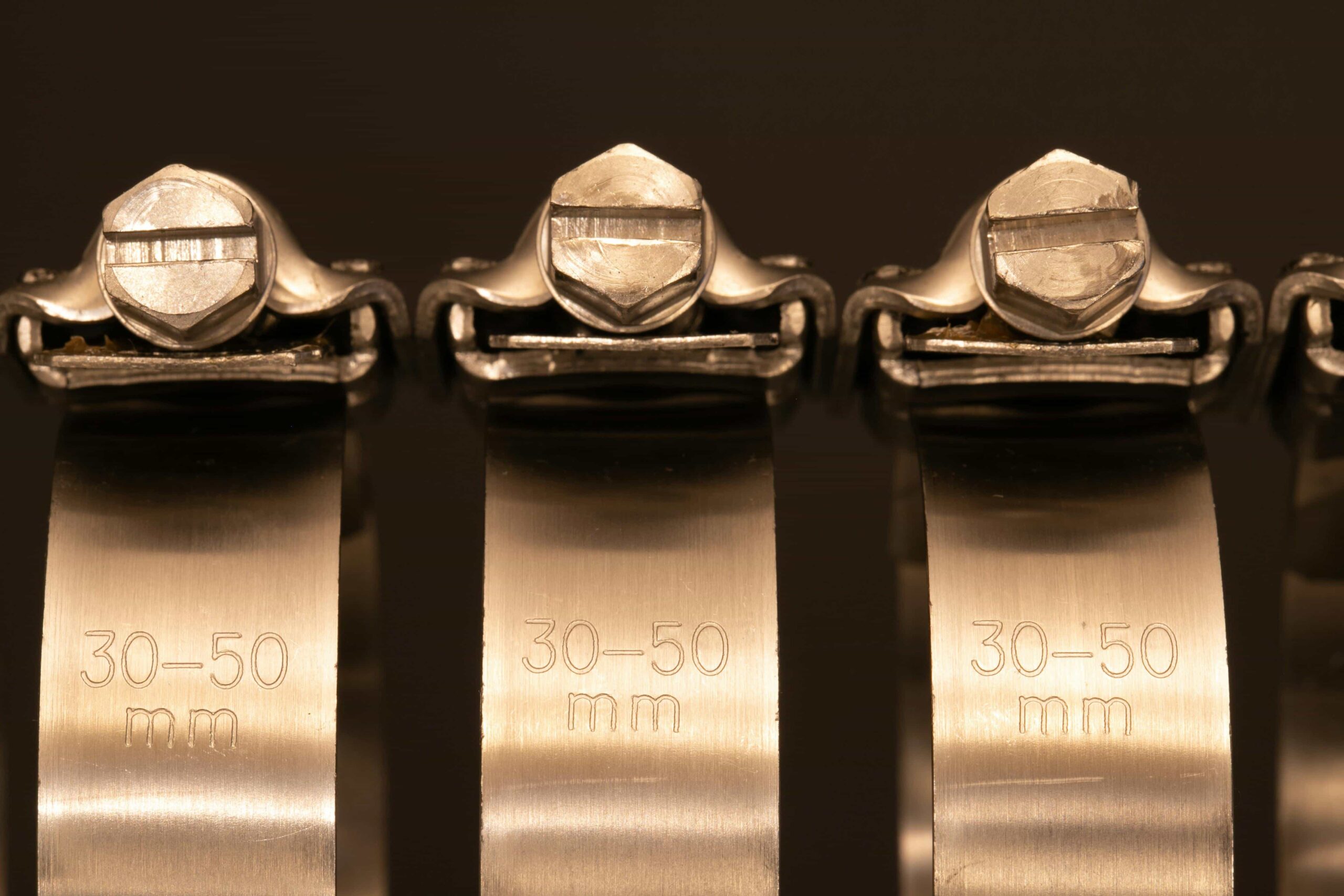
- High-Torque Worm Drive Clamps: Unlike standard clips, these feature thickened bands and housing to allow for much higher installation torque without stripping.
What Are Hose Clips?
The term “hose clip” is most commonly used in British English and European markets (MRO and automotive). While it serves the same fundamental purpose as a clamp—securing a hose to a fitting—the term often implies a lighter-duty, more versatile, or specifically “low-profile” fastener.
The Role of the Stainless Steel Hose Clip
When a professional specifies a stainless steel hose clip, they are typically looking for a solution for standard plumbing, automotive cooling, or low-pressure fluid transfer. Clips are favored for their:
- Versatility: Most clips (especially worm-gear designs) have a wider adjustment range than heavy-duty T-bolt clamps.
- Compact Design: Clips are often slimmer, making them ideal for tight engine bays or crowded manifold assemblies where a bulky bolt mechanism wouldn’t fit.
- Weight Sensitivity: In industries like aerospace or high-performance automotive, the lighter weight of a clip compared to a heavy industrial clamp is a significant advantage.
Standard Clip Variations
- Worm Drive Clips: The most recognizable “Jubilee” style clip, featuring a slotted band and a screw.
- Spring Clips: Used for constant tension in systems that experience frequent temperature fluctuations (like car radiators).
- P-Clips: Primarily used for mounting hoses or cables to a wall or chassis rather than sealing a connection.
Key Differences Between Hose Clips and Clamps
While the names are often used interchangeably in casual conversation, B2B buyers must distinguish between them based on three technical pillars: Pressure Capacity, Mechanical Mechanism, and Band Construction.
1. Pressure and Torque Capacity
The most significant difference lies in how much “squeeze” the fastener can apply.
- Clamps: Built to handle high torque. For example, a T-bolt clamp can often be tightened with a pneumatic impact wrench (within spec) to create a seal on rigid, wire-reinforced industrial hoses.
- Clips: Designed for hand-tool tightening. While a stainless steel hose clip is incredibly strong for its size, over-tightening can strip the slots in the band or deform the screw housing.
2. Band Design and Hose Protection
- Clips: Many standard worm-drive clips have “perforated” bands (slots cut all the way through). In soft silicone hose and clamp setups, the hose material can squeeze through these slots, causing damage.
- Clamps: Heavy-duty clamps almost always feature a “solid band” with a smooth underside. This prevents “hose extrusion” and ensures that the pressure is distributed evenly across the entire 360 degrees of the hose surface.
3. Regional and Industry Terminology
- Regional: In the USA, almost everything is called a “clamp.” In the UK and Australia, “hose clip” is the dominant term for light-to-medium duty fasteners.
- Industry: In the hydraulic and pneumatic industries, “clamp” is the preferred technical term to signify a high-pressure rating. In the HVAC and general automotive repair sectors, “clip” is the standard.
Material Science: Why Stainless Steel is Non-Negotiable
Whether you are selecting hose clip types or heavy-duty clamps, the material grade is the most critical factor for B2B longevity. In industrial environments, carbon steel is rarely sufficient due to oxidation.
Grade 304 (A2) Stainless Steel
The industry standard for most indoor and automotive applications. It offers excellent resistance to water and common chemicals. Most professional stainless steel hose clip products are made from 304.
Grade 316 (A4) Stainless Steel
The “Marine Grade” choice. If your project involves saltwater exposure, chemical processing, or food-grade environments, 316 is required. It contains molybdenum, which prevents pitting and crevice corrosion.
Galvanized Steel (The “Budget” Pitfall)
Galvanized steel is carbon steel with a thin zinc coating. While cheaper, it is a poor choice for long-term B2B applications. Once the zinc layer is scratched during installation, the clamp will begin to rust, leading to connection failure and potentially expensive environmental leaks.
Finding the Perfect Fit: A Procurement Checklist
Selecting the wrong size is the leading cause of “leaking under pressure.” Follow this protocol for accurate sourcing:
1. The “Loaded” OD Measurement
Never measure a hose when it is sitting on a shelf. To find the right hose and clamp match, you must measure the Outside Diameter (OD) after the hose has been pushed onto the fitting. The fitting will expand the hose material; a clamp that fits a “dry” hose might be too small for the “loaded” assembly.
2. The Adjustment Range
- For Clips: Look for a clip where your hose OD falls in the middle of the adjustment range. This ensures you have enough “tail” to tighten but not so much that the excess band becomes a safety hazard.
- For Clamps: T-bolt clamps have very narrow ranges (e.g., 64mm–67mm). Precision is mandatory here.
3. Vibration Factors
If the assembly is on a vibrating engine or a pump, a standard clip may back off over time. In these cases, look for “Constant Torque” clamps or clips that feature a spring-loaded washer mechanism to maintain tension.
Application Spotlight – When to Use Which?
To help B2B buyers navigate their inventory, we have categorized the most common applications for hose clip types versus industrial clamps.
When to Source Hose Clips:
- Commercial Kitchens: Securing water lines to dishwashers and sinks.
- Light Automotive: Vacuum lines, windshield washer fluid, and low-pressure fuel returns.
- Agriculture: Low-pressure drip irrigation and sprayer systems.
- HVAC: Securing flexible ducting or condensation drain lines.
When to Source Heavy-Duty Clamps:
- Marine Engines: Raw water intake and wet exhaust systems where a failure could sink the vessel.
- Industrial Hydraulics: Systems moving oil or glycol under significant pressure.
- Mining and Construction: Suction and discharge hoses on dewatering pumps.
- Turbine Engineering: Securing intercooler pipes on large-scale power generators.
Maintenance, Inspection, and Safety Standards
In a B2B environment, a failed hose connection is a liability. Implementing a “Fastener Integrity Program” can prevent accidents and environmental fines.
The 24-Hour Retighten Rule
Hose materials, especially rubber and silicone, undergo “cold flow” or “creep” after the initial compression. For critical hose and clamp installations, it is standard professional practice to check and retighten the fastener 24 hours after installation.
Inspection Red Flags:
- “Tail” Length: If the tail of a worm-drive clip is too long, it can snag on clothing or cut a technician’s hand. Use plastic safety caps.
- Red Dust (Rust): Even on a stainless steel hose clip, if low-quality screws were used by a sub-par manufacturer, you will see “bleeding” rust. This indicates the integrity of the screw is compromised.
- Hose Bulging: If you see the hose material “mushrooming” around the edges of the clamp, the clamp is too narrow for the pressure, or it has been over-torqued.
Conclusion: Bridging the Gap Between Clips and Clamps
While the global market may use different words, the engineering reality remains the same: the connection is only as strong as its weakest point. Whether you call it a stainless steel hose clip or a heavy-duty industrial clamp, the priority is matching the fastener’s mechanical strength to the system’s pressure and environmental demands.
For procurement managers, the key is to look past the label. Focus on the material grade (preferring 304 or 316), the band construction (solid vs. perforated), and the specific torque requirements of your project. By understanding the different hose clip types and their heavy-duty clamp counterparts, you ensure that your hose and clamp assemblies provide a leak-free, high-performance solution for years to come.